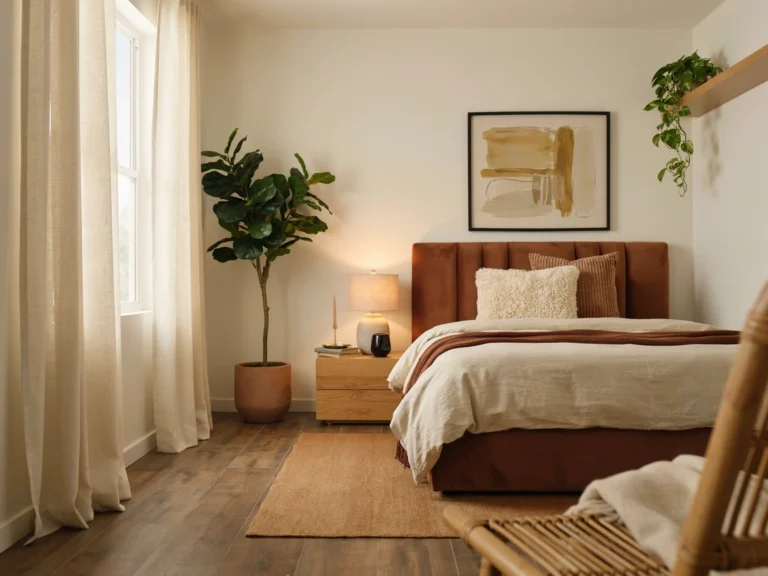
21 Stunning Modern Luxury Bedrooms (And the Budget-Friendly Way to Copy Them)
Here are 21 genuinely different looks, each with the reasoning behind why it works and a realistic way to recreate it without a full renovation budget.
Warm Neutral & Quiet Luxury
1. Sage Green Accent Wall with Natural Oak

A sage green wall paired with natural oak furniture creates an instantly calming space without feeling cold or sterile. It’s one of the easiest ways to add color without committing to something bold.
This look works especially well in smaller rooms since it leans on clean lines and light textures instead of bulky furniture.
- Paint one wall in muted sage, keep the rest neutral
- Pair with natural oak or light wood furniture
- Use ceramic lamps for warm, soft lighting
- Keep artwork minimal and simple
- Budget swap: peel-and-stick sage wallpaper instead of paint
Small-Space Note: This palette works especially well in compact bedrooms, since light tones keep the room feeling open.
2. Warm Taupe & Linen Layering

Taupe bedding and linen curtains create a cozy, welcoming feel that works for bedrooms doing double duty as a workspace or reading nook. Nothing here feels precious — it’s luxury you can actually live in.
The trick is layering: a wooden chair, soft textiles, and just enough greenery keep the room from feeling flat.
- Choose taupe or warm beige as your base bedding tone
- Add linen curtains for a relaxed, breathable texture
- Bring in a single wooden accent chair
- Let outdoor greenery double as your wall decor
- Budget swap: thrifted wooden chair instead of a new designer piece
3. Blush & Cream Soft Glow

Blush walls, creamy whites, and a cascading chandelier create a soft, almost storybook glow. It’s a quietly elegant option for anyone who wants romance without looking overdone.
The key is restraint elsewhere in the room — let the chandelier and color palette do the talking.
- Combine blush walls with creamy white bedding
- Add one statement chandelier for drama
- Keep pillow patterns tonal, not clashing
- Use a tufted bench for extra softness
- Budget swap: a flush-mount fixture styled to look like a mini chandelier
Why It Works: The soft color pairing photographs beautifully in low light, which is part of why this look performs so well on Pinterest.
4. Creamy Whites with Warm Wood

This is the safest, most timeless option on the list — creamy whites paired with warm wood tones. It photographs well, ages well, and works for almost any home style.
Large windows and a tailored curtain finish the look without adding visual noise.
- Stick to a cream and warm wood color story
- Choose tailored, not fussy, curtains
- Add oversized art above the bed for drama
- Keep bedding soft white with subtle texture
- Budget swap: a large printable art piece instead of a custom canvas
5. Beige Tonal Layering

Layering different shades of beige sounds boring until you see it done well. The subtle variation between bedding, walls, and decor creates depth without adding a single “extra” color.
It’s one of the lowest-effort looks to maintain since everything already matches.
- Layer at least three shades of beige or taupe
- Add one textured throw for visual interest
- Keep decor minimal and functional
- Choose matte, not glossy, finishes
- Budget swap: layer thrifted textiles in matching tones
Design Secret: Designers often use this exact tonal-layering trick to make a small budget look expensive — it’s about coordination, not cost.
Moody & Dramatic Palettes
6. Deep Green Biophilic Retreat

Deep forest green walls next to wood-grain furniture bring a grounded, natural feel into the bedroom — part of the wider shift toward biophilic design that connects indoor spaces back to nature. If deep green tones are your thing, this dark green bedroom color guide has more ways to work the shade into a full room.
Vertical slatted panels behind the bed add architectural interest without needing extra decor.
- Choose a deep, saturated forest green for walls
- Pair with warm wood-grain furniture
- Add vertical slatted wood panels behind the bed
- Use modern pendant lighting to draw the eye up
- Budget swap: a green accent wall instead of full-room paint
7. Dark Tufted Headboard & Knit Throw

A dark tufted headboard paired with a chunky knit throw creates a cozy, evening-focused bedroom. It leans into deeper tones without feeling heavy, thanks to soft lighting balancing things out.
This is a great option if your current bedroom feels flat and needs more visual weight.
- Choose a dark tufted or upholstered headboard
- Add a chunky knit throw at the foot of the bed
- Balance dark tones with soft ambient lighting
- Layer bedding in warm, muted colors
- Budget swap: a knit throw from a big-box store instead of a designer brand
Common Mistake: Going too dark everywhere at once can make a room feel smaller — balance it with soft lighting and lighter walls.
8. Terracotta Statement Wall

A terracotta accent wall brings warmth and depth that few other colors can match. Paired with vertical wood slats, it softens into that “quiet luxury” feel instead of looking loud.
Neutral linens and pampas grass keep the terracotta from overwhelming the room.
- Use terracotta on one wall only, not the full room
- Pair with vertical wood slats for texture
- Balance with neutral linens and creamy bedding
- Add pampas grass or dried florals for softness
- Budget swap: a terracotta-toned curtain instead of a paint commitment
9. Black & Caramel Contrast

This one leans into contrast with confidence — black and white patterns set against rich caramel tones. Bold, but never chaotic, and it doesn’t shy away from personality. For more ways to use black as an anchor tone, this black accent wall bedroom guide breaks down several approaches.
It works best when the pattern stays contained to one or two elements, like bedding or a rug.
- Pair black and white patterns with caramel wood tones
- Keep patterns limited to one or two elements
- Add candlelight or warm lighting to soften contrast
- Use woven textures to bring warmth back in
- Budget swap: a patterned duvet cover instead of custom bedding
Statement Lighting & Ambiance
10. Brass Sconces & Fluted Paneling

Fluted wall paneling paired with brass sconces gives a bedroom that boutique-hotel precision. The repeated vertical lines create rhythm, while the brass adds a subtle glow.
This is a great option if your room feels a little plain and needs texture without adding clutter.
- Add fluted or channel paneling behind the bed
- Install brass sconces at eye level on either side
- Keep the rest of the palette neutral and calm
- Use symmetry to reinforce the elegant feel
- Budget swap: peel-and-stick fluted panels instead of custom millwork
11. LED Underglow Bed Frame

A floating bed frame with warm LED underglow, paired with a raw stone wall, creates a cinematic, high-end feel. It’s dramatic without needing much else in the room.
The contrast between rough stone texture and soft warm light is what makes this look feel so intentional.
- Choose warm white LEDs (2700K–3000K), never cool white
- Diffuse the LED strip so you see a glow, not individual dots
- Pair with a raw stone or textured accent wall
- Keep bedding minimal so the glow stands out
- Budget swap: a plug-in LED strip kit instead of hardwired lighting
Cost Note: A basic warm-white LED strip kit costs far less than custom under-bed lighting installation, with a similar visual payoff.
12. Crystal Chandelier Drama

A cascading crystal chandelier instantly elevates a bedroom, even when the rest of the palette stays soft and simple. It’s a single statement piece doing most of the visual work.
Pair it with a soft palette so the chandelier feels like the focal point, not competition.
Design Highlights:
- Choose one statement chandelier as the room’s focal point
- Keep the surrounding palette soft and neutral
- Avoid competing patterns elsewhere in the room
- Use dimmable bulbs for evening ambiance
- Budget swap: a smaller chandelier scaled to room size instead of an oversized fixture
13. Layered Pendant Lighting

Slender pendant lights on either side of the bed add depth without cluttering the nightstands. This is a simple lighting swap that instantly makes a room feel more considered.
It works especially well when paired with a restrained, minimal color palette.
- Install slender pendants instead of table lamps
- Keep nightstands clear for a cleaner look
- Choose warm-toned bulbs for coziness
- Pair with a minimal, neutral bedding palette
- Budget swap: plug-in pendant kits that don’t require rewiring
Texture & Materials
14. Velvet Headboard & Blush Tones

A velvet headboard adds depth and softness without feeling heavy, especially inside a blush and cream color scheme. Twin stools at the foot of the bed bring in a quiet sense of symmetry. If warm neutrals are more your speed than blush, this tan bedroom furniture roundup is worth a look too.
This look prioritizes comfort over showiness — nothing feels overly styled, yet it all comes together.
- Choose a velvet headboard in a muted tone
- Add twin stools for symmetry at the foot of the bed
- Keep bedding soft and tonal
- Use warm lighting to enhance the velvet’s texture
- Budget swap: a velvet headboard cover instead of a full custom frame
15. Boucle Chairs & Structured Canopy

Rounded boucle chairs paired with a structured canopy bed create a space that feels balanced between soft and architectural. It’s calm without feeling plain.
The contrast in shapes — round versus structured — is what keeps this look visually interesting.
- Add one or two rounded boucle accent chairs
- Pair with a structured, angular canopy bed frame
- Keep the palette soft and neutral throughout
- Use texture, not color, to create contrast
- Budget swap: boucle throw pillows instead of full boucle chairs
16. Raw Stone Accent Wall

A raw stone wall brings elemental texture that feels almost architectural. Paired with a halo of warm lighting, it frames the bed like a piece of art rather than just a backdrop.
This look works best when everything else in the room stays minimal, letting the stone take center stage
- Use raw or textured stone tile on one wall only
- Add halo or uplighting to highlight the texture
- Keep bedding and furniture minimal
- Pair with slender pendant lighting
- Budget swap: textured stone wallpaper instead of real stone tile
17. Chunky Knit & Layered Rugs

Layered rugs and a chunky knit throw bring tactile warmth to a room, grounding it even when the rest of the palette is simple. A raw wood bench adds one more textural layer without extra color.
Every piece here adds weight and warmth, making the room feel intentional rather than sparse.
- Layer two rugs of different textures
- Add a chunky knit throw at the foot of the bed
- Include a raw wood bench for grounding
- Keep the color palette neutral so texture leads
- Budget swap: a single textured rug instead of full layering
Architectural & Structural Details
18. Vertical Wood Slat Wall

Vertical wood slats behind the bed bring texture and height, paired with soft pendant lighting for a warm, almost hotel-like glow. It’s one of the most repeated design choices in 2026 bedrooms for good reason — it works.
Plush bedding softens the structure so the room doesn’t feel too rigid.
- Install vertical wood slats behind the bed only
- Pair with warm pendant or sconce lighting
- Soften with plush, layered bedding
- Add rounded decor pieces to offset the straight lines
- Budget swap: a wood slat wall panel kit instead of custom carpentry
19. Curved Feature Wall

A feature wall with gentle curves adds depth without overwhelming the space. Soft lighting highlights the shapes, creating an ambient glow that feels modern yet warm.
This is a subtle way to add architectural interest if you’re not ready for bold color or pattern.
Design Highlights:
- Use curved plaster or panel details on one wall
- Highlight with soft uplighting or wall washers
- Keep the rest of the room minimal
- Choose warm, muted paint tones for the curve
- Budget swap: curved wall decals or panels instead of plaster work
20. Ceiling Medallion & Modern Pendants

A detailed ceiling medallion paired with modern layered pendants feels like old-world craftsmanship meeting contemporary design. The rest of the space stays restrained so that ceiling detail can shine.
Sometimes the most memorable element isn’t at eye level — it’s what you almost overlook at first glance.
Design Highlights:
- Add a ceiling medallion above the main light fixture
- Pair with modern, layered pendant lighting
- Keep walls and furniture simple and restrained
- Let the ceiling be the room’s unexpected focal point
- Budget swap: a lightweight faux medallion instead of plaster
Design Secret: Designers often reserve their boldest detail for the ceiling specifically because it’s an area most rooms leave completely unused.
Small Space & Budget-Friendly
21. Small Modern Luxury Bedroom Layout

Luxury isn’t about square footage. A light palette, mirrors, and minimal furniture prove that even a small bedroom can feel like a retreat, not a compromise.
Keeping furniture low and tones light lets natural light do more of the design work.
Design Highlights:
- Choose a light, monochromatic color palette
- Add a mirror to visually expand the space
- Keep furniture low-profile and minimal
- Avoid bulky pieces that crowd the room
- Budget swap: a large thrifted mirror instead of a custom one
Room-Size Note: This approach works in bedrooms as small as 100 square feet, since the light palette prevents the space from feeling cramped.
Common Mistakes to Avoid
- Going too dark everywhere without balancing with soft, warm lighting
- Using cool-white LEDs instead of warm-white (2700K–3000K) for ambiance
- Choosing oversized furniture that overwhelms a smaller room
- Mixing too many patterns or finishes without a repeating thread
- Skipping lighting layers and relying on one overhead fixture alone
Designer Secrets
- Repeat 2–3 fabrics or finishes throughout the room for instant cohesion
- Layer lighting at three heights: ambient, task, and accent
- Reserve your boldest architectural detail for an unexpected spot, like the ceiling
Conclusion
Modern luxury doesn’t come from spending the most — it comes from restraint, texture, and lighting working together. Pick one style cluster from this list — warm neutral, moody, textured, or architectural — rather than mixing all 25, and let that one direction guide your next refresh. Save this guide so you’ve got it handy when you’re ready to start.