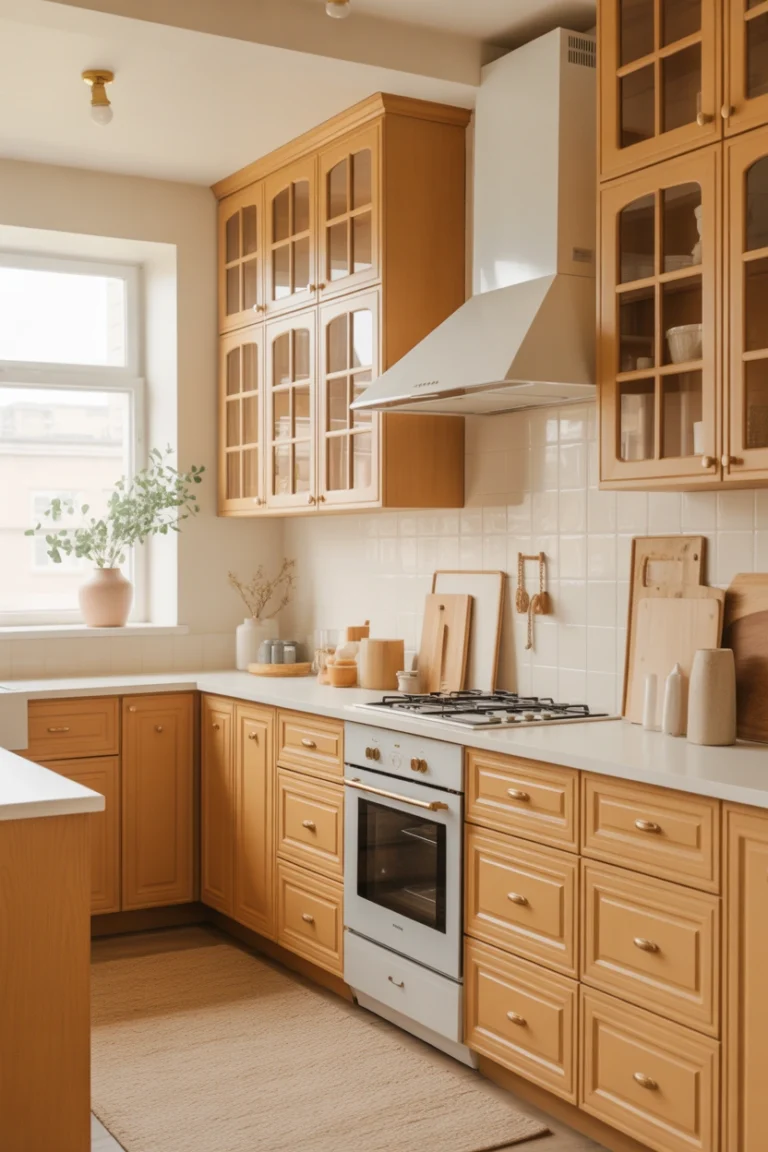
18 Italian Kitchen Ideas That Actually Work in Real Homes
You’ve seen the photos — sun-bleached walls, a bowl of lemons on a wood counter, copper pans hanging like they’ve been there for decades. It’s the kind of kitchen that makes you want to slow down and cook something simple, just because the room asks you to.
The tricky part is translating that into your actual kitchen. Maybe yours is small. Maybe it’s a rental. Maybe it’s already modern and you don’t want to rip anything out. Good news: the Italian kitchen look isn’t one fixed formula, and it doesn’t require a full renovation to get right.
Below are 18 ways to bring it into your space — organized so you can find the ones that actually fit your budget, layout, and lease.

What Actually Makes a Kitchen Look Italian?
Strip away the Pinterest boards and it comes down to three things:
Natural materials. Wood, stone, terracotta, and metal that’s allowed to show a little age — not glossy, not overly polished.
A warm, earthy palette. Terracotta, olive, warm white, mustard, and walnut tones instead of stark whites and cool grays.
Styling that looks used, not staged. Open shelves with dishes you actually reach for, a cutting board that’s seen some knife marks, herbs on the counter instead of behind glass.
You don’t need all three maxed out. Most real Italian-inspired kitchens lean on two of these heavily and use the third as an accent.
Italian Kitchen Colors, Explained
If you only change one thing, change the palette. The most common Italian kitchen colors are:
- Terracotta and brick red — the color of clay tile and sun-baked walls
- Olive green — muted, almost dusty, never neon
- Warm white and cream — softer than “true white,” closer to unbleached linen
- Mustard and ochre — used sparingly, usually as an accent
- Walnut and honey wood tones — for cabinetry, shelving, and floors
- Charcoal and matte black — for a more modern, Milanese take on the style
A simple rule of thumb: pick one earthy color as your anchor (terracotta or olive are the classics), one neutral to balance it (warm white or cream), and one wood tone to tie it together. That’s the whole palette — you don’t need six colors fighting for attention.
The Three Faces of Italian Kitchen Style
Here’s something most roundups skip: “Italian kitchen” isn’t one look. It’s at least three, and knowing which one you’re going for will save you from mixing styles that don’t actually belong together.
Tuscan farmhouse — rustic, wood-heavy, terracotta floors, visible beams. This is the “villa in the countryside” version.
Modern Milanese — sleek matte cabinetry, brass or black hardware, minimal ornamentation. This is the version you’ll see in city apartments.
Coastal Southern Italian — whitewashed wood, blue-and-white ceramics, lighter and brighter than Tuscan. Think Amalfi Coast rather than Tuscan hillside.
You can borrow from more than one, but pick a primary lane before you start buying paint or tile — it’s the fastest way to keep the room from feeling like three different Pinterest boards stitched together.
18 Italian Kitchen Ideas for Every Budget and Space
1. Terracotta and Olive Farmhouse Kitchen

Best for: full or partial renovations
This is the pairing most people picture when they think “Italian kitchen” — terracotta tile against olive cabinetry, with warm wood beams overhead. If a full floor replacement isn’t in the budget, use terracotta on the backsplash instead and let a simpler floor carry the rest of the room.
Keep pantry essentials organized with these rustic farmhouse pantry ideas, which bring the same warm, lived-in charm as an Italian-inspired kitchen.
2. Matte Black and Brass Modern Milanese Kitchen

Best for: modern homes and city apartments
If rustic isn’t your thing, this is the Italian look for people who want sophistication over coziness. Matte black cabinetry stays sharp and current, while brass hardware and warm lighting keep it from feeling cold. Brass is doing a lot of the work here — it’s the single fastest way to warm up an all-black kitchen without repainting anything.
If your kitchen already has warm wood tones, these honey oak kitchen cabinet ideas show how well that cabinetry pairs with an Italian color palette.
3. Whitewashed Coastal Amalfi Kitchen

Best for: small or low-light kitchens
Whitewashed wood, light stone, and small pops of blue-and-white ceramic bring in the brighter, sun-bleached feel of Southern Italy. It’s also genuinely practical advice for small kitchens — light, reflective surfaces make a tight room feel bigger. Pair it with linen curtains instead of heavy drapery so the light keeps moving through the space.
4. Budget Italian Refresh (Paint and Hardware Only)

Best for: renters and tight budgets
You can get most of this look without touching your cabinets structurally. Repaint them in a warm cream or muted olive, swap the hardware for something in brass or aged bronze, and add textiles in an earthy tone. One well-chosen accent wall color will do more for the “Italian” feel than new cabinets will — it’s the cheapest lever you have.
Not sure what to pair with those cabinets? These backsplash ideas for honey oak cabinets offer tile and color combos that suit an Italian kitchen’s earthy tones.
5. Open Shelving with Copper and Ceramic Styling

Best for: any kitchen size
Open shelves are where the “lived-in” part of the style actually lives. Hang a few copper pans, stack ceramics you actually use, and resist the urge to fill every inch. The rule that keeps this from looking cluttered: only display what you reach for at least once a week. If it’s purely decorative, it belongs in a cabinet.
6. Marble Waterfall Island

Best for: larger or open-concept kitchens
A marble island with a waterfall edge gives you a genuine luxury focal point without redoing the whole kitchen around it. Keep the surrounding cabinetry simple — plain wood or a single matte color — so the stone stays the star instead of competing with a busy backsplash.
Working with a smaller footprint? These basement kitchenette ideas prove Italian-style warmth can work even in a compact layout.
7. Small Italian Kitchen, Curated Not Cluttered

Best for: apartments and compact layouts
The biggest myth about this style is that it needs space. It doesn’t — it needs restraint. In a small kitchen, pick one hero material (a tile, a wood tone) and build around it instead of layering five materials the way a larger kitchen can afford to. A pale base palette with one warm accent will read as intentional rather than cramped.
8. Vintage-Style Range with Classic Tile Backsplash

Best for: mid-renovation budgets
A vintage-style range face — even one with a standard oven underneath — becomes the visual anchor of the room. Pair it with a patterned or classic tile backsplash and brass knobs, and the appliance itself does the decorating instead of needing extra decor layered around it.
For another take on rustic European charm, these chic cottage kitchen ideas share the same cozy, textured appeal as an Italian kitchen.
9. Warm Wood-Paneled Walls

Best for: modern homes that feel too cold or sterile
Covering a wall (or a full run of cabinetry) in honey-toned wood paneling is a one-material fix for a kitchen that feels flat. Go with handle-free cabinets underneath to keep the look clean, and keep your countertop light so the room doesn’t tip into feeling like a cabin.
10. Renter-Friendly Italian Look

Best for: renters and temporary spaces
Peel-and-stick terracotta-look tile, removable wallpaper in an olive or cream print, and freestanding open shelving get you most of the way there without violating a single lease clause. Always test removable products on a hidden spot first — some older cabinet finishes don’t play well with adhesive.
11. Green Marble and Walnut Statement

Best for: kitchens that want drama without going fully dark
Green marble on an island or backsplash paired with rich walnut cabinetry is moody without being heavy. Keep hardware minimal here — simple black or brass pulls — so the stone and wood grain stay the focus instead of competing with ornate fixtures.
12. Cotto Tile Flooring Focus

Best for: partial renovations where cabinets are staying put
If your cabinets are fine but the room still feels generic, the floor might be doing the damage. Cotto (Italian terracotta) flooring under simple white or cream cabinetry carries the whole aesthetic on its own. One practical note: seal terracotta flooring properly, or it will stain faster than you’d expect in a working kitchen.
13. Warm Pendant Lighting for Ambiance

Best for: any kitchen, any budget
Sometimes the palette and materials are right but the room still feels flat — and it’s almost always the lighting. Swap cool-white bulbs for warm-toned ones before you buy anything new; it’s the cheapest fix in this entire list. Then layer in pendant lights and under-cabinet strips for the soft, glowy feel Italian kitchens are known for.
14. Cream, Marble, and Leather Layering

Best for: families and everyday-use kitchens
Cream cabinets, a marble-topped island, and tan leather counter stools create a soft, elegant base that still holds up to daily life. If marble feels risky with kids or heavy cooking, a quartz alternative gets you the same look with a lot less maintenance anxiety.
15. Dark, Dramatic Kitchen with Wood Warmth

Best for: bold, statement-seeking homeowners
An all-black palette can absolutely still feel Italian — it just needs a counterweight. Vertical wood slats over the upper cabinets and warm under-cabinet lighting keep a dark kitchen from tipping into cold or clinical. Without that wood element, though, black alone reads as modern-minimalist rather than Italian.
16. Herb and Ceramic Tabletop Styling

Best for: any kitchen, any budget
This is the detail work that separates a “designed” kitchen from a lived-in one. Fresh herbs, a bowl of lemons, mismatched flea-market ceramics, and linen napkins cost almost nothing and do more for authenticity than a lot of the bigger changes on this list. The trick: rotate a small number of real, functional pieces rather than buying things purely to look at.
17. Galley Kitchen, Italian Style

Best for: narrow or galley layouts
Long, narrow kitchens can absolutely pull this off — you just have to manage light and sightlines carefully. Backlit glass upper cabinets add glow without visual weight, while matte taupe lower cabinets keep things grounded. Light-colored uppers in particular keep a narrow galley from feeling boxed in.
18. Avoid the “Prop Kitchen” Look

Best for: everyone
This isn’t a material or color choice — it’s the mistake that undoes all seventeen ideas above. An Italian kitchen is supposed to feel lived-in, and over-styling it with decorative-only objects (fake produce, unused cookbooks stacked for color) reads as staged rather than warm. A simple filter: if you wouldn’t actually use it, it probably doesn’t belong on your open shelf.
Getting the Look on a Budget
You don’t need a renovation budget to make real progress here. In order of impact per dollar:
- Paint — cabinets or a single accent wall in a warm, earthy tone
- Hardware — swap to brass or aged bronze pulls and knobs
- Lighting — warm-toned bulbs, then pendant fixtures
- Textiles — linen curtains, table runners, tea towels in earthy colors
- Styling objects — ceramics, herbs, a wood cutting board left out on the counter
Most of that list is reversible, which makes it renter-friendly by default.
Small Italian Kitchen Tips
- Pick one hero material instead of layering several
- Keep the base palette light (cream, warm white) and use one earthy accent color, not three
- Open shelving reads as more spacious than upper cabinets in a tight room — but only if it’s not overloaded
- Mirrors or glass-front cabinets can bounce light around a small space
- Skip heavy, dark drapery — linen or no window treatment at all keeps the room feeling open
Mistakes to Avoid
- Over-styling. Purely decorative props make a kitchen look staged, not authentic.
- Mixing regional styles without a plan. Tuscan wood beams next to sleek Milanese matte black can clash if there’s no unifying color or material tying them together.
- Going too cool with your whites. Stark, blue-toned white reads as modern-minimalist, not Italian. Look for warm or cream-based whites instead.
- Forgetting lighting. The right materials and colors can still fall flat under harsh, cool-white light.
- Skipping the “why.” Choose a primary style lane (Tuscan, Milanese, or Coastal) before buying anything, so your choices reinforce each other instead of pulling in different directions.
Frequently Asked Questions
What makes a kitchen look Italian style? Three things, mainly: natural materials (wood, stone, terracotta), a warm earthy color palette, and styling that looks lived-in rather than staged. You don’t need all three at full intensity — most kitchens lean on two and use the third as an accent.
What is the difference between Italian and Tuscan kitchen style? Tuscan is actually a subset of Italian style — specifically the rustic, countryside version with wood beams, terracotta floors, and farmhouse details. “Italian kitchen” is the broader umbrella that also includes sleeker Modern Milanese and brighter Coastal Southern Italian looks.
What colors are used in Italian kitchens? Terracotta, olive green, warm white or cream, mustard, walnut and honey wood tones, and — for the more modern take — charcoal or matte black as an accent.
Can you get an Italian kitchen look on a budget? Yes. Paint, hardware swaps, warm lighting, and textiles get you most of the way there without touching cabinetry structurally. It’s the single most overlooked path to this style.
What backsplash material is most common in Italian kitchens? Terracotta and cotto tile are the classic choices, though patterned or majolica-style tile also shows up frequently in more traditional Tuscan-leaning kitchens.
Do Italian-style kitchens need an island? No. Islands work well in larger, open-concept spaces, but galley and small kitchens can absolutely achieve the look through material, color, and lighting choices alone.
Is Italian kitchen style good for small kitchens or apartments? Yes, with one adjustment: stick to one hero material and a lighter base palette instead of layering multiple materials the way a larger kitchen can afford to.
What’s the difference between Italian and Mediterranean kitchen style? Mediterranean is a broader regional category that includes Greek, Spanish, and Southern French influences alongside Italian. Italian style specifically tends toward warmer, earthier tones (terracotta, olive) versus the cooler blues and whites more common in Greek-influenced Mediterranean kitchens.
Conclusion
An Italian kitchen isn’t a single recipe — it’s a framework: natural materials, a warm earthy palette, and styling that looks used rather than staged. Once you pick a primary style lane (Tuscan, Milanese, or Coastal) and work within your actual budget and space, you don’t need a full renovation to get there. Start with paint, lighting, and a few honest, functional objects on the counter — the rest can come later.